Pesticide use reduced as alternative weed control takes over
Published: Thursday 22 October 2026
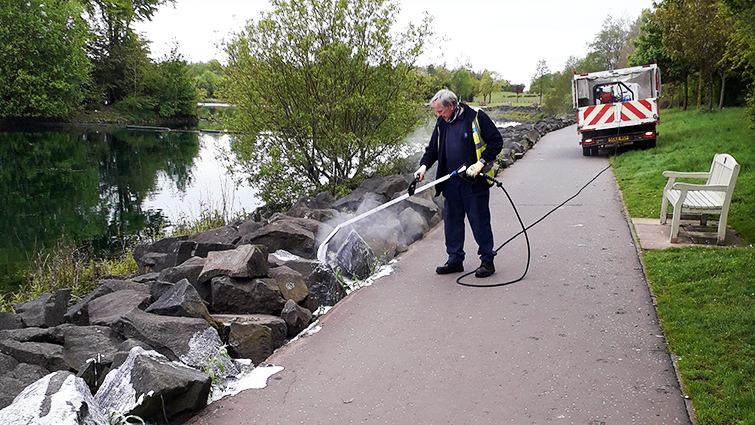
There has been a reduction of almost 30% in pesticide use by the council over the past few years.
In line with proposals by the council to become pesticide-free, work has been ongoing to reduce their use and invest in alternative means of controlling weeds including hot foam application at specific locations and mechanical control of weed growth across South Lanarkshire.
These updates were set out in a report submitted to the Climate Change and Sustainability Committee as part of the council’s ongoing Pesticide Free Motion.
Councillor Norman Rae, the chair of the council’s Climate and Sustainability Committee, said: "I am delighted to hear that following extensive trials using a variety of alternative methods of control and a reduction in areas treated over several years, the council can demonstrate that we have reduced the use of pesticides and glyphosate-based herbicides.”
Since 2019, when Ground Services started looking into alternatives, the volume of pesticides has reduced from 4,462 litres to 3,203 litres in 2025, representing a reduction of 1,259 litres (28.2%) over the period, showing a sustained downward trend in pesticide use, reflecting the council’s ongoing efforts in the absence of a reliable and affordable alternative to minimise pesticide application, where operationally practicable.
Herbicide use has also been significantly reduced in certain areas, particularly along grass edges, around trees and adjacent to play area fencing.
The majority of play areas are no longer treated with herbicides except at older facilities where concrete or asphalt surfaces are still prevalent.
In and around schools, herbicides are only used during school holidays.
Andrew Stokes, the Head of Facilities, Waste and Grounds Services, said: “Additional investment has now allowed increased use of small mechanical sweepers to control weeds, especially along high footfall areas, further reducing the need to use herbicides or pesticides.
“Our grounds officers continue to monitor and review these arrangements to ensure compliance with operational requirements and support the council's ongoing commitment to reducing pesticide use as much as possible.”


22 October 2026
Pesticide use reduced as alternative weed control takes over
21 October 2026
Donation helps charity build on work that sees children SMILE
19 October 2026
Resurfacing on way for road between Muirkirk and Strathaven
16 October 2026
First class reports for schools across South Lanarkshire
15 October 2026
Tenants settling in at new development in East Kilbride
14 October 2026
Never too early to think about the Christmas lights switch on events
14 October 2026
Archaeology group can do more digging thanks to funding
13 October 2026
Remember, remember, bonfire and fireworks displays need a licence
13 October 2026
Launch for vital report on health and poverty
13 October 2026
New council homes on the way in East Kilbride